Install charging station for your business
Having a charging station installed at your company means choosing a suitable charging point, having the grid connection checked and hiring a certified installer. In this article you will read exactly when you need to comply with the legislation, what the costs are and what subsidies (such as MIA and VAMIL) are available. We also explain the step-by-step installation process so that you are well prepared for the switch to electric driving for your employees and visitors.
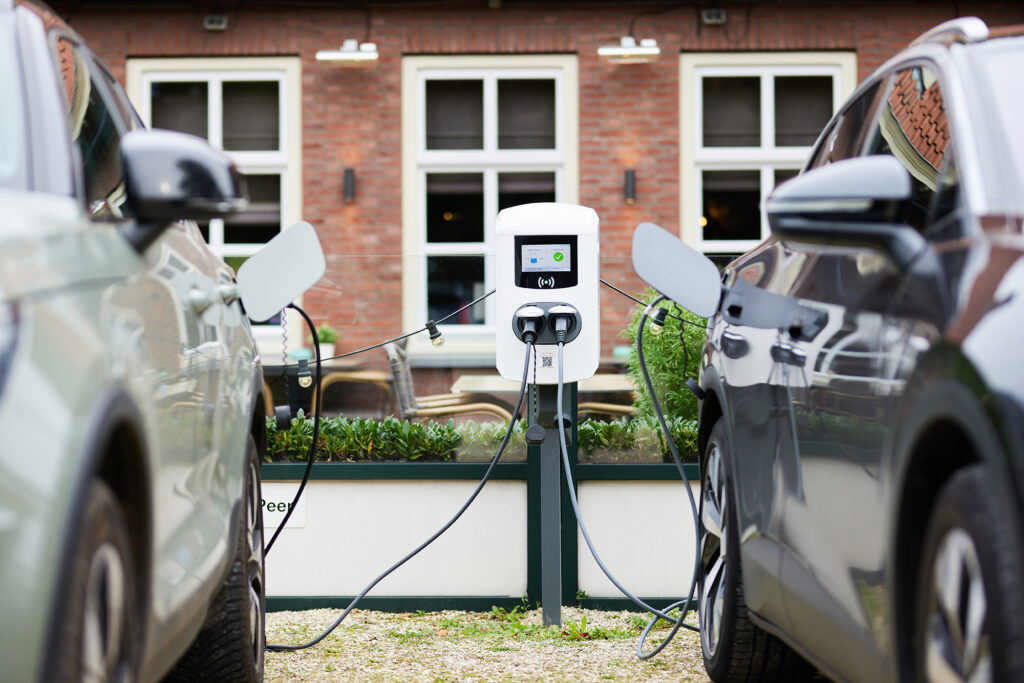
When are you required to install a charging station?
Since 2025, as a business owner of a property with 20 or more parking spaces, you are required to install at least one charging point. This rule stems from the European Energy Performance of Buildings Directive (EPBD III). New construction and buildings undergoing major renovation are often subject to even stricter requirements.
Use the checklist below to determine if the obligation applies to you:
- Existing utility buildings: Do you have 20 or more parking spaces on your property? If so, at least one charging station is already required now.
- New construction utility buildings: For more than 10 parking spaces, there must be at least one charging point and piping infrastructure must be provided for at least one in five spaces.
- Major renovation: Is an existing building with more than 10 parking spaces being substantially renovated? If so, the same rules apply as for new construction.
It is advisable to look ahead now to 2027, when requirements may be further tightened. See how to make your business sustainable with charging solutions here or read more about the legal requirements for building energy performance.
Where do you place the charging stations: office, grounds or employees' homes?
The best spot for your charging station depends on three factors: available space, type of parking and the needs of your employees. There are roughly three scenarios:
- Private company lot: Ideal for charging your own electric company cars or lease cars during the day.
- Office parking lot: Here you can also deploy semi-public charging stations on your business premises, allowing visitors and guests to charge for a fee.
- At employees’ homes: Do your employees drive their own electric cars to the office? Then consider a contribution for home charging through the untaxed travel allowance of 0.23 euros per kilometer.
Keep in mind that visitors also increasingly expect loading capacity when they arrive at your office.
Which charging station is suitable: power, type and load balancing
Choosing the right charging station for your business depends on how fast cars need to be able to charge. The table below shows the most common options:
Type of charger
1-phase AC
3-phase AC
DC fast charger
Power
~3.7 kW
11 / 22 kW
50+ kW
Ideal application
Long parking hours (e.g., employees at home)
Office locations (charging during working hours)
Logistics hubs and locations with short visits
Load balancing and smart charging
Do you have multiple charging stations on the same premises? If so, load balancing is essential. This system cleverly distributes the available power among the charging stations so that multiple cars can charge at the same time without the main fuse blowing out or you having to costly increase your grid connection. This is the ideal business charging station for companies without investment.
Here's how the installation goes: roadmap in 6 steps
Learn more about our process for installing charging stations at businesses.
What does a business charging station cost including installation?
A business charging station including installation costs on average between 2,000 and 4,500 euros excluding VAT. The final price strongly depends on the type of charging station, the distance to the meter box and any additional options such as load balancing.
Here is a rough cost breakdown:
- Hardware (charging station): 800 – 2,000 euros.
- Installation & Assembly: 700 – 1,200 euros.
- Excavation: On average, 45 euros per meter.
- Extras: Meter box upgrade or double charging station (on request).
Rather not invest yourself? With the Opcharge model, we install the charging stations at our expense and take all the worry out of your hands.
Charging and reimbursement to employees
When employees charge their business electric car at home, you can reimburse these charging costs untaxed via the travel allowance of 0.23 euros per kilometer. Another commonly used method is a direct kWh reimbursement based on actual consumption and applicable energy rates.
By comparison, driving 100 kilometers at a consumption of 18 kWh/100km and a rate of 0.35 euros per kWh costs about 6.30 euros. At public charging stations, these rates are often higher than at your own business. View the current charging rates per kWh at Opcharge here.
Tax benefits and subsidies (MIA, VAMIL, SPRILA)
The government encourages the purchase of charging stations for your business with various schemes:
- MIA (Environmental Investment Allowance): Allows you to deduct up to 45% of investment costs from profits.
- VAMIL: Provides the opportunity to randomly depreciate 75% of investment costs, which provides a liquidity advantage.
- SPRILA: A specific grant for charging infrastructure at logistics companies.
Calculation example: Do you invest 5,000 euros? Then you can deduct up to an additional 2,250 euros from your profit through the MIA. Depending on your tax rate, this provides a net benefit of approximately 500 to 950 euros. Look for the current conditions on the MIA and VAMIL scheme at RVO.
Don't forget the e-bike: charging stations for electric bikes
Are your employees increasingly using electric bikes for their commutes? If so, consider charging points for e-bikes. A covered, dry and lockable bicycle shed with sufficient sockets is often sufficient. After all, the included charger fits into any normal electrical outlet. This contributes to a complete and sustainable charging infrastructure for the entire team.
Charging infrastructure without investment: what Opcharge does for you
Not in the mood for a large upfront investment? Opcharge offers a unique solution where we finance, install and manage the entire charging infrastructure. You then only pay for the electricity actually consumed (pay-per-use).
This model is ideally suited for healthcare organizations, property managers and logistics companies that prefer to reserve their capital for their core business. We arrange everything turnkey: from the initial inspection to 24/7 breakdown service. Interested? Discover our business charging station without investment.
Frequently asked questions about installing charging station for your business
What subsidies are there for a charging station?
Companies can take advantage of the Environmental Investment Allowance (MIA) and the Random Depreciation of Environmental Investments (VAMIL). For logistics companies, there is also the SPRILA subsidy for large-scale charging infrastructure.
Is it mandatory for a company to install a charging station?
Yes, since 2025, businesses with more than 20 parking spaces are required to have at least one charging station. New construction or major renovations of properties with more than 10 parking spaces are often subject to even more stringent requirements for charging infrastructure and preparatory piping.
Who gets to install charging stations?
Charging poles should always be installed by a certified installer. Working with high power in the meter box requires specific knowledge of NEN 1010 standards to ensure fire safety and proper operation.
What does a charging station cost including installation?
A business charging station including installation costs on average between 2,000 and 4,500 euros excluding VAT. The hardware usually costs between 800 and 2,000 euros, while installation costs vary between 700 and 1,200 euros, depending on the excavation work required.