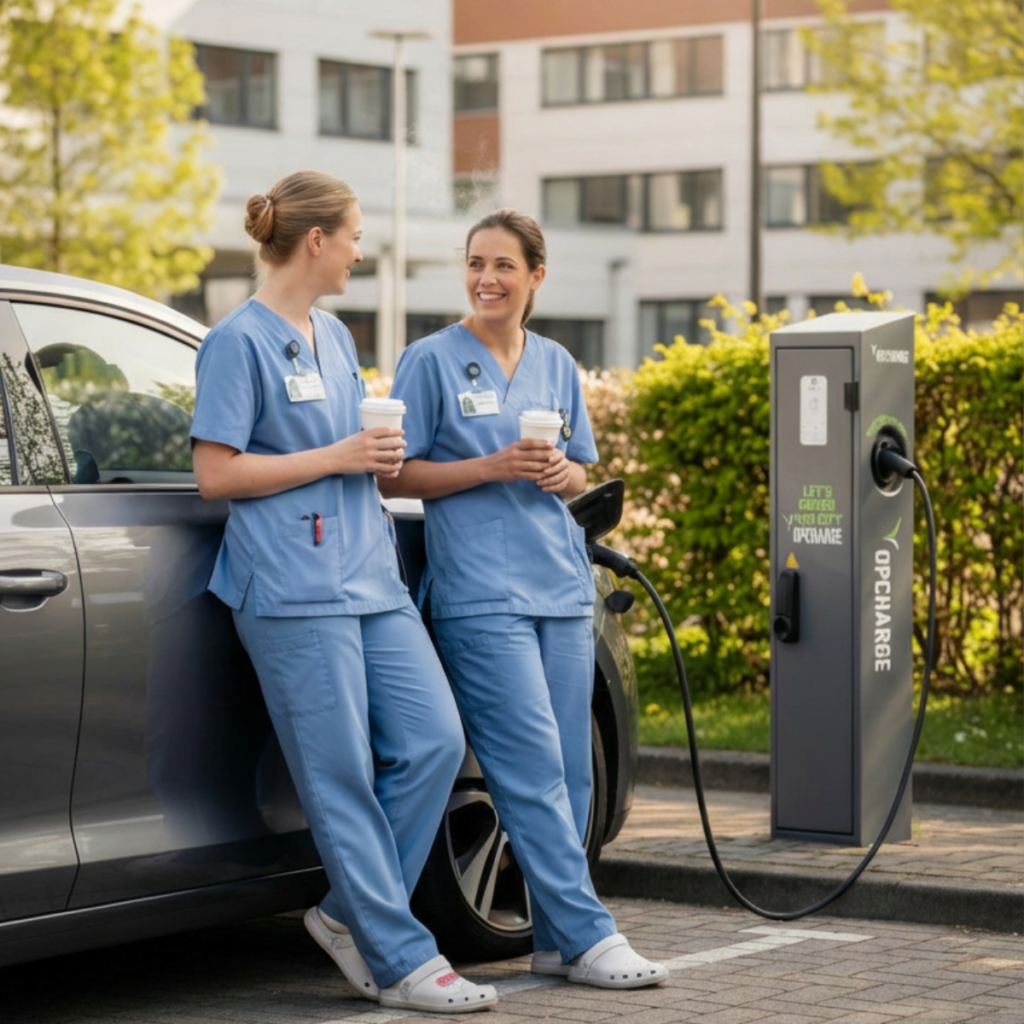
More and more parking lots at healthcare facilities have electric cars at charging stations. Employees charge their cars between appointments, visitors charge during longer visits and suppliers are also increasingly switching to electric transport.
Electric driving is thus becoming more and more normal. For healthcare organizations, this raises an important question: what does this mean for our location?Not only in terms of parking spaces, but also in terms of energy consumption and available capacity.
The growth of electric driving within healthcare
Mobility is essential in healthcare. Medical specialists travel between locations, district nurses drive from patient to patient, and visitors and suppliers stop by throughout the day. The number of electric drivers is growing at a rapid pace. At the beginning of 2025, some 570,000 fully electric passenger cars were on the road in the Netherlands; at the beginning of 2026, there were nearly 700,000, a growth of 22 percent in one year. Counting plug-in hybrids and regular hybrids, the Netherlands will reach over 2 million cars with an electric motor over 1 in 5 passenger cars by early 2026.
And this growth will continue apace: by 2025, 86 percent of all new cars sold will have an electric motor. For healthcare organizations, this means that the demand for charging points on their own premises will increase significantly in the coming years. It usually starts with one employee or visitor asking if there will be a charging station. After that, more and more will follow.
Charging stations are therefore increasingly seen as part of a site’s basic infrastructure. Just like parking lots or lighting. At the same time, this raises new questions about energy use and available capacity. And the urgency is great: to reach the national goal of 1.7 million charging points by 2030, nearly one million more charging points must be added. That means that the rate of installation must become more than four times higher than it is now. Those who start on time will avoid capacity problems later.
Net congestion: is it going to fit?
The term grid congestion comes up more and more often. This can make it seem like the power grid is full.
In practice, the issue is often not a shortage of power, but simultaneous use of power. And the situation is more pinching than many organizations realize. Currently, more than 14,000 large consumers are already on the waiting list for a (heavier) electricity connection. In many regions, expanding the power grid takes at least one to two years, and in some places the waiting time has risen to three years or longer. Moreover, starting July 1, 2026, small consumers will also be put on the waiting list if the grid in their area is full. Those who do not have a plan for their charging infrastructure now run the risk that in a few years, expansion simply cannot be arranged at short notice.
Within healthcare facilities, energy consumption is already high due to medical equipment, air conditioning systems and lighting, for example. Therefore, insight into energy use is important. With smart power management, available capacity can be better distributed and the system remains stable, often without the need to upgrade the connection. We explain in more detail exactly what this means in our blog on grid congestion.

Concern and misunderstanding
There is a specific concern within the healthcare sector: the potential impact of charging stations on medical equipment. This is understandable, as medical equipment can be sensitive to malfunctions. In addition, as a hospital, you want to ensure that you can help and care for your patients at all times.
Disruption can be prevented in two ways. The first way is load balancing. This means that the available power is cleverly distributed among the charging poles so that charging automatically adjusts to what the property needs at the time. For example, when medical equipment or climate systems require a lot of power, charging automatically scales back. In this way, charging never places an extra burden on the systems that are essential to care. The second way is that charging stations are placed on a separate electrical connection, making them completely separate from the facilities that power medical equipment. In practice, this means that charging stations do not affect medical equipment when installed correctly. However, that careful installation does require preparation: between application, design, grid connection and full delivery, there is easily several months at a healthcare site.
Wondering what this means for your location? We make a no-obligation scan of your location in which we map out the possibilities together with you. Feel free to contact us, we would like to think along with you.
Mobility and healthcare real estate are growing together
Electric transportation will continue to increase in the coming years. For healthcare organizations, this means that mobility will increasingly converge with issues around energy, sustainability, future-proof real estate and legislation. And on that last point, healthcare organizations will face a lot in the coming years.
Since Jan. 1, 2025, there has already been a legal obligation for hospitals and other non-residential buildings with more than 20 parking spaces: these locations must have at least one electric vehicle charging station. And that obligation will be further tightened in the coming years. In fact, starting in 2027, at least one in ten parking spaces at non-residential buildings must have a charging point. For a healthcare facility with hundreds of parking spaces, that can quickly add up to dozens of charging points. With the current network congestion and shortage of installers, this cannot be done overnight. 2027 may sound far away, but there is often one to two years between application, grid connection and actual installation. If you don’t have a plan now, you risk not meeting your obligation in time.

By understanding energy use and charging needs in time, healthcare facilities can prepare their sites for this development step by step.
Wondering how other healthcare facilities have handled this? On our healthcare page you will find several cases of locations that we have already assisted: [link to care page]. Or schedule a no-obligation site scan, so together we can see what is possible for your location. Please contact us, we are happy to help you.