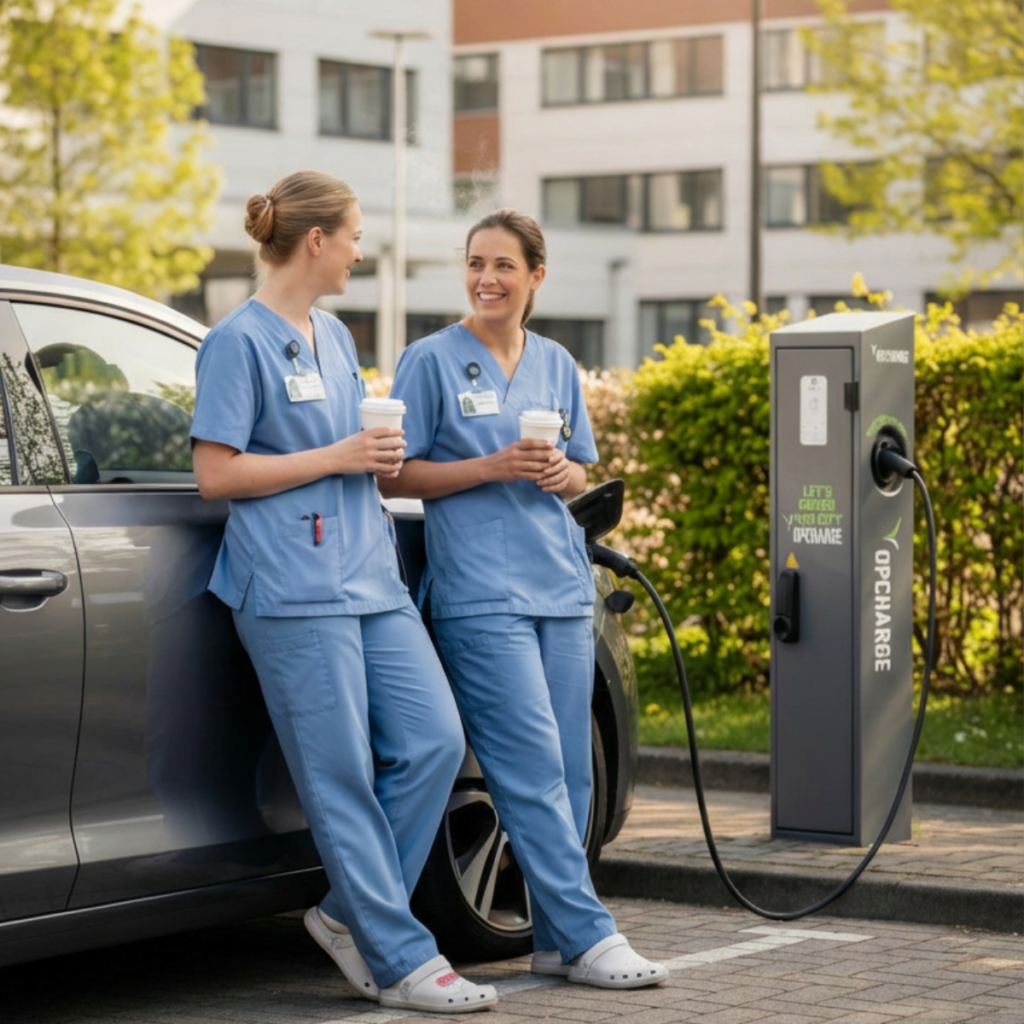
More and more parking lots of healthcare facilities have electric cars at the charging station. Employees charge between appointments, visitors during their stay, and suppliers are switching to electric transportation in droves.
Electric driving is becoming the standard. For healthcare organizations, this raises important questions about parking capacity, energy consumption and power grid load.
The rapid growth of electric mobility
Mobility is the lifeblood of healthcare. Think of medical specialists traveling between locations, district nurses driving from patient to patient and the constant stream of visitors and suppliers.
The numbers show that the transition is gaining momentum:
- By early 2026, there will be nearly 700,000 fully electric cars on the road in the Netherlands. Including hybrids, the total comes to more than 2 million cars with a plug: that is 1 in 5 passenger cars.
- The trend continues unabated. By February 2026, as many as 88.8 percent of all new cars sold were (semi) electric vehicles. This amounts to nearly 20,000 cars per month in immediate need of charging facilities.
This means that nearly 20,000 new cars requiring a plug are being added every month. So for your healthcare organization, the demand for charging stations is no longer incidental. It often starts with that one employee or visitor asking for a charging station, but the rest are now following at a rapid pace.
Net congestion: is it going to fit?
The power grid is getting full. In practice, there is often not a shortage of power, but a shortage of simultaneously available power. The numbers show the urgency:
- More than 14,000 wholesale customers are on the waiting list for a heavier connection.
- Waiting times for grid expansion range from 1 to 3 years.
- Starting July 1, 2026, small consumers will also be on the waiting list when the power grid is full.
Understanding your energy profile is therefore essential. With smart power management, you can smartly distribute the available capacity without having to add weight to the main connection.

No impact on medical equipment
A common misconception is that charging stations can cause malfunctions in sensitive medical equipment. With proper installation, there is no such risk. This is ensured in two ways:
- Dynamic Load Balancing: Charging automatically scales back as soon as critical systems such as climate control or medical equipment demand more power.
- Separate infrastructure: The charging points are placed on a completely separate connection. This makes them physically separate from the installations that power your equipment.
Wondering how we have ensured safety at other healthcare sites? Then check out our various case studies on the website.
Legislation: 2027 coming sooner than you think
The government is significantly tightening the rules for existing construction (all buildings that are not residential). Do you have a healthcare facility with 20 or more parking spaces? If so, the following obligations apply:
- Since Jan. 1, 2025: At least one charging point must already be present.
- Starting in 2027: Requirements get stricter to keep up with the growth of electric driving. You must then meet one of the following two requirements:
- Minimum of 1 charging point per 10 parking spaces.
- Or: Lozenge conduits (pre-piping for cabling) to at least 50 percent of parking spaces.
Given the current grid congestion and wait times at installers, it’s smart to determine now which route is most efficient for your location. By laying conduits now during scheduled maintenance, you avoid having to reopen the parking lot later.

No investment required
Creating a professional charging plaza requires an investment in hardware, installation and management. We find that many healthcare facilities are unaware that this can be done differently. Free installation is possible in many cases.
By choosing an operating model, the charging station operator assumes the investment, maintenance and management. That way you comply with legislation and offer service to your visitors without sacrificing the budget for care.
Prepared for the future
By gaining insight into your charging needs and energy consumption now, you will transform your care location step by step into a future-proof environment. This way, you not only comply with legislation, but also offer the service that employees and visitors expect today.
Want to know what the options are for your location?
We are happy to help you get this clear. Leave your details in our inquiry form and we will contact you for a no-obligation location scan. During this scan we will look together at your current connection, the parking capacity and how we can smartly prepare your care location for the future.
Curious about examples from other healthcare facilities? On our specific healthcare page you will find several real-life stories, the benefits for healthcare locations and additional information about our approach in healthcare.